

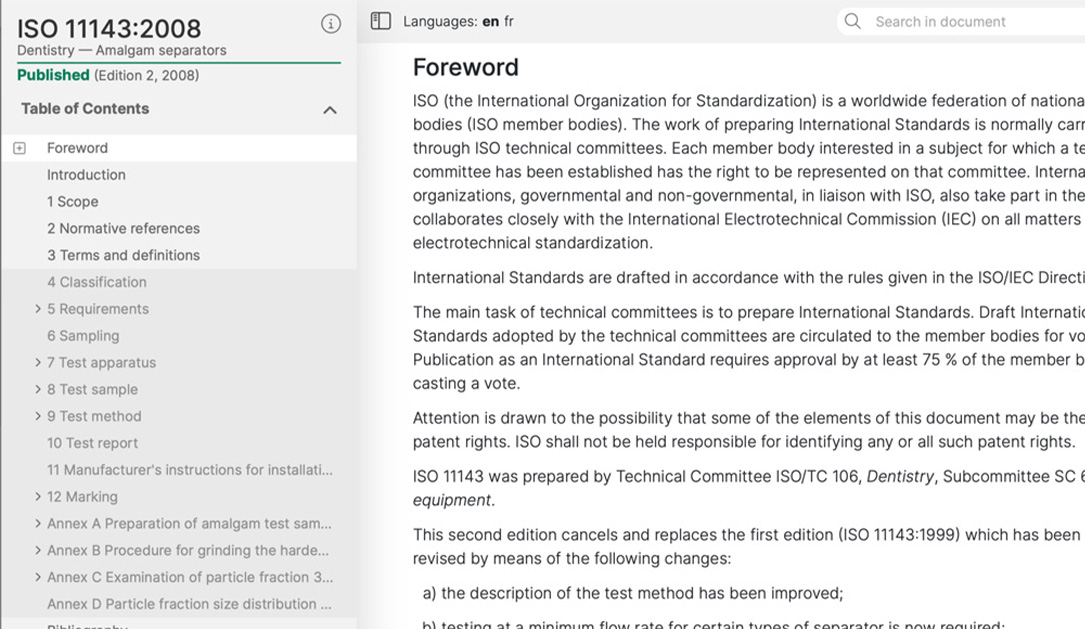
Every amalgam separator worth buying gets described with a removal-efficiency number — 95%, 98%, 99%. That number isn’t a marketing invention. It comes from a specific international standard, ISO 11143:2008, and understanding what the standard measures is the difference between comparing units on real terms and comparing them on brochure adjectives. Here’s the standard, decoded.
What ISO 11143:2008 is
ISO 11143:2008 is the international standard titled Dentistry — Amalgam separators. It does two things:
- It specifies requirements for amalgam separators used with dental equipment — including safety, marking, and instructions for use, operation, and maintenance.
- It defines the test method for measuring how well a separator retains amalgam, expressed as a removal-efficiency percentage.
It’s the reference point the EPA’s dental amalgam rule points to. When 40 CFR Part 441 says a separator must remove at least 95% of amalgam, ISO 11143:2008 is the test that determines whether it does.
The 95% floor — and why the test is tough
Under ISO 11143:2008, a separator must retain at least 95% of amalgam by mass to pass. What makes the number meaningful is how it’s measured.
The test doesn’t use convenient, easy-to-catch chunks. It uses a precisely graded sample of amalgam engineered to mimic what actually comes out of a dental treatment room — a blend of three particle sizes:
- Coarse: particles from about 3.15 mm down to 0.5 mm.
- Medium: particles from 0.5 mm down to 0.1 mm.
- Fine: particles smaller than 0.1 mm — and half of that fraction is finer than 0.01 mm.
That fine fraction is the hard part. Catching gravel-sized bits is easy; catching particles a hundredth of a millimeter across is where separators are actually tested. The graded sample is designed so a unit can’t pass just by trapping the big stuff.
The detail most people miss: empty AND full
Here’s the part that separates a serious standard from a marketing claim. ISO 11143:2008 requires efficiency to be measured under both empty and full conditions.
Why it matters: a brand-new, empty separator with all its capacity available will catch particles well. The real question is whether it still performs when it’s loaded with collected amalgam — because that’s the state it spends most of its service life in. A unit that only hits its rated efficiency when empty isn’t protecting you in month eleven. Testing full is how the standard keeps "99% efficient" honest.
This is also the practical link between efficiency and capacity. As we cover in how separators work, a filling unit has less room to slow the water and settle particles, so efficiency drops as it loads. A bigger collector holds its efficiency longer between services — which is the whole argument for capacity.
So what does "99% removal efficiency" actually claim?
When a unit is described as "99% removal efficiency, exceeding ISO 11143:2008," it’s making a specific, testable statement: run the standard’s graded amalgam sample through the unit, and it retains 99% by mass — four points above the 95% floor the standard sets, across the empty-and-full test.
Four percentage points may not sound like much until you remember what’s escaping. The difference between 95% and 99% is the difference between letting 5% of the amalgam through and letting 1% through — a fivefold reduction in what reaches the sewer. On the fine fraction, where mercury is most mobile, that margin is exactly where you want it. It’s the number we build our separators to hit, and it’s why we cite the standard by name rather than a vague "high efficiency."
How to use the standard when you’re comparing units
A few practical takeaways when you’re evaluating any separator:
- Ask for the ISO 11143:2008 rating, not a generic efficiency claim. The standard is the common yardstick.
- Confirm it’s 95% or better — that’s the compliance floor. Higher is better, and 99% is the mark to look for.
- Ask whether the rating is empty-and-full — it should be, under a proper ISO test.
- Remember capacity is part of efficiency. A high rating on a tiny collector means frequent changes to keep that rating; a high rating on a large collector means it holds up between annual services.
Frequently asked questions
Is ISO 11143:2008 the same as the EPA requirement?
They work together. The EPA rule sets the 95% removal requirement; ISO 11143:2008 is the test standard used to demonstrate a separator meets it.
Is a higher removal-efficiency percentage always better?
Higher is better for what escapes to the sewer, yes — but pair it with capacity. A high efficiency that only holds when the unit is nearly empty means constant maintenance. Efficiency plus a large collector is the combination that lasts.
My old records mention ISO 14011 — is that the standard?
No. ISO 14011 is an environmental-auditing standard and was cited in error in some older dental materials. The correct amalgam-separator standard is ISO 11143:2008.
Removal efficiency isn’t a vibe — it’s a measured number against a demanding, internationally recognized test. Know the standard, ask for the rating, and pair the percentage with real capacity. Do that and you’ll never be sold on an adjective again.
Rebec Environmental
Manufacturer of stainless steel amalgam separators, ADA-endorsed since 1995. Written for dental practices navigating amalgam compliance.