

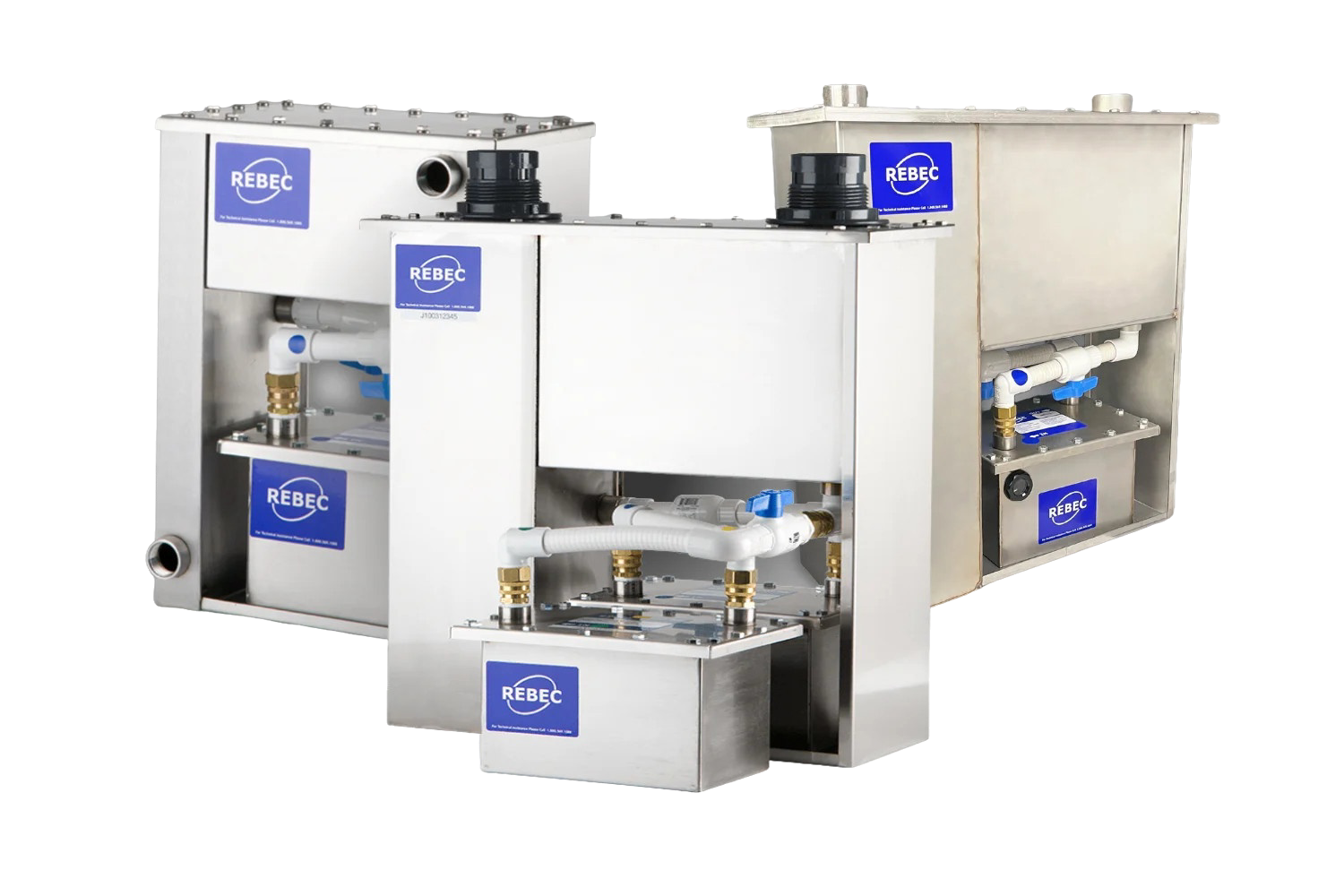
You know what a separator is and that it’s federally required. This guide opens the box: how the unit actually pulls mercury out of your wastewater, why capacity is the number that quietly decides everything, and what "99% removal efficiency" means in practice.
The basic principle: slow the water down
Amalgam is heavy. The silver-colored particles that come loose during dental work are far denser than water, and that single fact is what makes separation possible. When wastewater from your chairside drains and vacuum system rushes toward the sewer, it’s moving too fast for those particles to settle. A separator’s core trick is to slow that flow down inside a chamber, giving the heavy amalgam time to drop out and collect at the bottom while the clarified water continues on.
Most separators use one or more of three methods to do this:
- Sedimentation (gravity settling). The water enters a large chamber and slows. Dense amalgam particles sink and collect; lighter water rises and exits. Simple, reliable, and effective when the chamber is big enough to actually slow the flow.
- Filtration. The water passes through a filter medium that traps particles by size. Effective for fine particles, but filters clog and need replacing — and a clogging filter can restrict suction at the chair.
- Centrifugation. Some systems spin the water to fling dense particles outward. Effective, but mechanically more complex.
Many quality units combine methods — for example, sedimentation to catch the bulk of the amalgam and a filter stage to polish out the fines. The goal is the same regardless of method: capture the particles across the full size range, from coarse chunks down to the microscopic fraction, and hold them safely until the collector is serviced.
Why capacity is the whole game
Here’s what the sales sheet often buries. A separator only works while it has room to work. As amalgam collects, the working volume of the chamber shrinks. In a sedimentation unit, a chamber that’s filling up slows the water less, so particles have less time to settle and more of them escape. In a filter unit, a loading filter both clogs and lets fines through as it saturates.
In other words, a full separator doesn’t just "stop having space" — it quietly stops separating. The device is still bolted to the wall, still passing a glance, but mercury is slipping through. This is the single most important thing to understand about how these units behave, and it’s why capacity and a real service schedule matter more than the brochure’s headline efficiency number.
This is also where the material of the unit starts to matter. Plastic separators are typically built with small collection chambers, which is why they need cartridge changes every several weeks in a busy practice. Larger stainless steel systems carry several times the collector capacity — enough to run a full year on a single collector change — because stainless doesn’t flex or crack under the powerful vacuum a practice pulls, so the chamber can be built bigger and last longer.
What "removal efficiency" actually measures
You’ll see separators advertised with a removal-efficiency percentage — 95%, 98%, 99%. That number isn’t marketing fluff; it comes from a specific laboratory test defined by the international standard ISO 11143:2008.
The test is deliberately tough. A precisely graded sample of amalgam — a mix of coarse, medium, and fine particles, with a real chunk of the sample smaller than a hundredth of a millimeter — is run through the separator, and the standard measures what fraction, by mass, the unit retains. To pass, a separator has to capture at least 95%. Crucially, the test is run under both empty and full conditions, because a device that only performs when brand-new isn’t much use in a real utility room.
So when a unit is described as "99% removal efficiency, exceeding ISO 11143:2008," that’s a specific, testable claim: it retains 99% of that graded amalgam sample, comfortably above the 95% floor the standard sets. We unpack the standard and why 99% is the number worth caring about in our dedicated guide to removal efficiency.
From capture to compliant disposal
Capturing the amalgam is only half the story. Once it’s in the collector, it’s hazardous waste, and it has to leave your building the right way — recycled or sent to a licensed hazardous-waste facility, never rinsed down a drain or tossed in the regular trash. The collector gets swapped, the full one goes off for mercury recovery, and you get documentation proving the chain of custody for your compliance file.
In a well-designed program, none of that is your staff’s problem. The unit runs, a service partner swaps the collector on schedule, the waste is recycled, and the paperwork appears in your records automatically. That’s the model Rebec is built around, and it’s why the "how it works" answer isn’t just about the box on the wall — it’s about the box plus the service behind it.
The short version
A separator slows your wastewater down so heavy amalgam particles settle out and collect; it works only while it has capacity, so a full unit silently stops protecting you; efficiency is a real, tested number against ISO 11143:2008 with a 95% floor; and the captured waste has to be recycled or disposed of as hazardous material.
Get those four ideas and you understand these units better than most of the people selling them. If you want a system sized to your practice so capacity is never the thing that trips you up, that’s the conversation we’re built for.
Rebec Environmental
Manufacturer of stainless steel amalgam separators, ADA-endorsed since 1995. Written for dental practices navigating amalgam compliance.